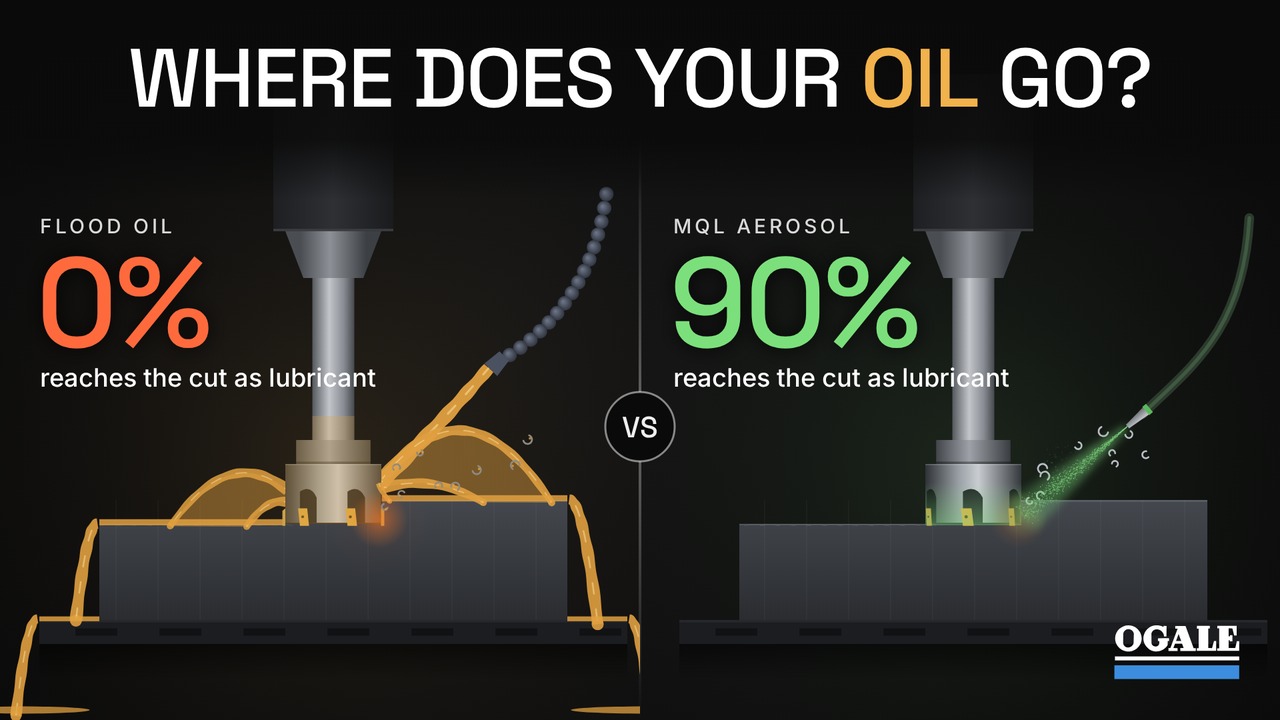
Four benefits, measured and proven.
Every advantage of MQL traces back to one principle: lubricate exactly where you need to, exactly as much as you need to. Here's how that translates into shop-floor outcomes.
Up to 40% longer tool life.
The single biggest cause of premature tool failure isn't wear: it's thermal shock. Flood coolant rapidly cools the tool when it touches the workpiece, then lets it heat back up when the cut breaks. Repeat this cycle thousands of times and you get micro-fractures in the cutting edge.
MQL keeps the tool at a consistent temperature throughout the cut. No thermal cycling. No micro-fractures. Just longer tool life.
- Eliminates thermal shock at the cutting edge
- Reduces tool-change frequency, increases utilisation
- Lower consumable cost on inserts and end mills
Up to 30% faster cycle times.
Once thermal limits are removed, you can run the cut harder. Higher feed rates, higher cutting speeds, higher RPM, without sacrificing surface finish or tool life. That's the operational advantage MQL unlocks.
Shops that switch from flood coolant to MQL routinely see 20–30% reductions in cycle time on the same machine, with the same operator, on the same parts.
- Higher cutting speeds without thermal damage
- Direct increase in machine output per shift
- Shorter lead times on every job
Up to 50% lower consumable cost compared to other imported MQL brands.
A flood coolant system needs water, 7-15 litres of coolant oil charge per day, biocide, filtration media, sump cleaning, and waste disposal. The recurring cost is significant, and that's before you count maintenance time.
MQL needs compressed air and a small amount of oil. Ogale MQL typically uses 1-2.5 litres per day depending on the model. No water. No biocide. No disposal cost.
- No water, no biocide, no filtration consumables
- No coolant disposal or wastewater treatment
 OMSecolube is up to 50% cheaper than other imported MQL oils
More than 99% vegetable-based lubricant.
The lubricant matters as much as the system. OMSecolube is more than 99% vegetable-based and formulated to be non-hazardous and biodegradable based on ingredient data.
For workers on the shop floor, this means cleaner air and far less skin contact than flood coolant. For your facility, it means no hazardous waste, no wastewater treatment, easier dry-chip disposal, and a cleaner path to ESG compliance.
- Vegetable-based, designed for shop-floor use
- Formulated to be biodegradable based on ingredient data
- Supports ESG compliance in machining operations